Axiomatic Mathematics
- Mathematics, from the Greek words “mathema” meaning “science, knowledge, and learning”, and “mathematikos” meaning “fond of learning”.
- Axiomatic Mathematics or Modern Mathematics, then, refers to
- the current formal Axiomatic system that is based on rigorous logical foundations.
- the science of operations on collections of arbitrary objects.
- This BASICALLY means that mathematics is the art of inventing and exploring rules that apply to any kind of object or dataset, so long as we define them carefully. Whatever that means.
- Developed using the following structure and Components of Modern Mathematics: Axioms > Definitions > Conjectures > Proofs > Theorems > Generalizations and Extensions
Mathematical/Logical Arguments
- Through Arguments, one tries to convince people to do or believe something.
- Deductive Argument: The conclusion is reached by logical arguments based on a collection of assumptions.
- Inductive Argument: Reasoning based on making inferences and conclusions from past observations. Used in making mathematical Conjectures.
Borrowed from Philosophy (Main) hehes!
Mathematical Shorthands
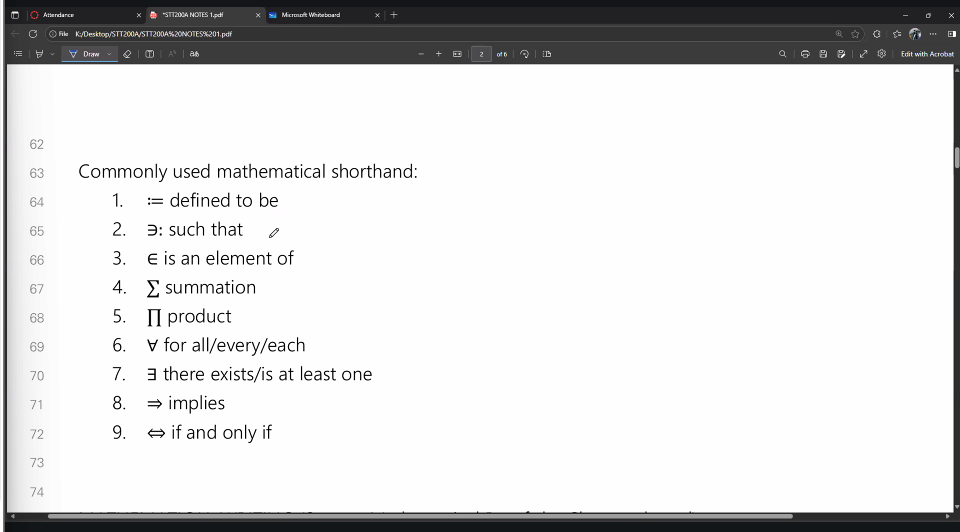
Link to original
Mathematical Shorthands
Mathematical Systems
Consists of the following:
- A set of elements (for Real Number System, elements are all real numbers)
- One or more relations expressing some kind of comparison among elements in the set ()
- One or more operations on the set of elements (, exponents, radicals)
- A list of basic rules or laws that govern the behavior of the elements under the operations and relations (Axioms)
Examples: Real Number System (), set theory (chapter 3), binary systems (only elements are and ).
Link to original
Mathematical Systems
Consists of the following:
- A set of elements (for Real Number System, elements are all real numbers)
- One or more relations expressing some kind of comparison among elements in the set ()
- One or more operations on the set of elements (, exponents, radicals)
- A list of basic rules or laws that govern the behavior of the elements under the operations and relations (Axioms)
Examples: Real Number System (), set theory (chapter 3), binary systems (only elements are and ).
Link to originalAxioms
Equality Axioms
- Reflexivity for Equality
- Symmetry for Equality
- Transitivity for Equality
- Substitution (Axiom)
Addition Axioms
- Closure for Addition
- Commutativity for Addition
- Associativity for Addition
- Existence of an Additive Identity
- Existence of an Additive Inverse
- Addition Property for Equality (APE)
Multiplication Axioms
- Closure for Multiplication
- Commutativity for Multiplication
- Associativity for Multiplication
- Existence of an Multiplicative Identity
- Existence of an Multiplicative Inverse
- Multiplicative Property for Equality (MPE)
Distributive Axioms
- Distributivity of Multiplication over Addition
- Trichotomy
- Transitivity for Inequality
- Addition Property for Inequality (API)
- Multiplication Property for Inequality (MPI)