Defn. Statements or Propositions
- A statement or proposition is a declarative sentence that is either definitely true or definitely false.
- The truth value of a proposition is either true (T) or false (F), but not both.
- Letters, such as are used to represent propositions.
- Propositional calculus is the area of logic that deals with propositions.
E.g. Statement: Seth Cordeta is from BS Stats. Truth Value: T.
Defn. Compound Statements
- A compound statement is composed of one or more propositions and at least one logical connective.
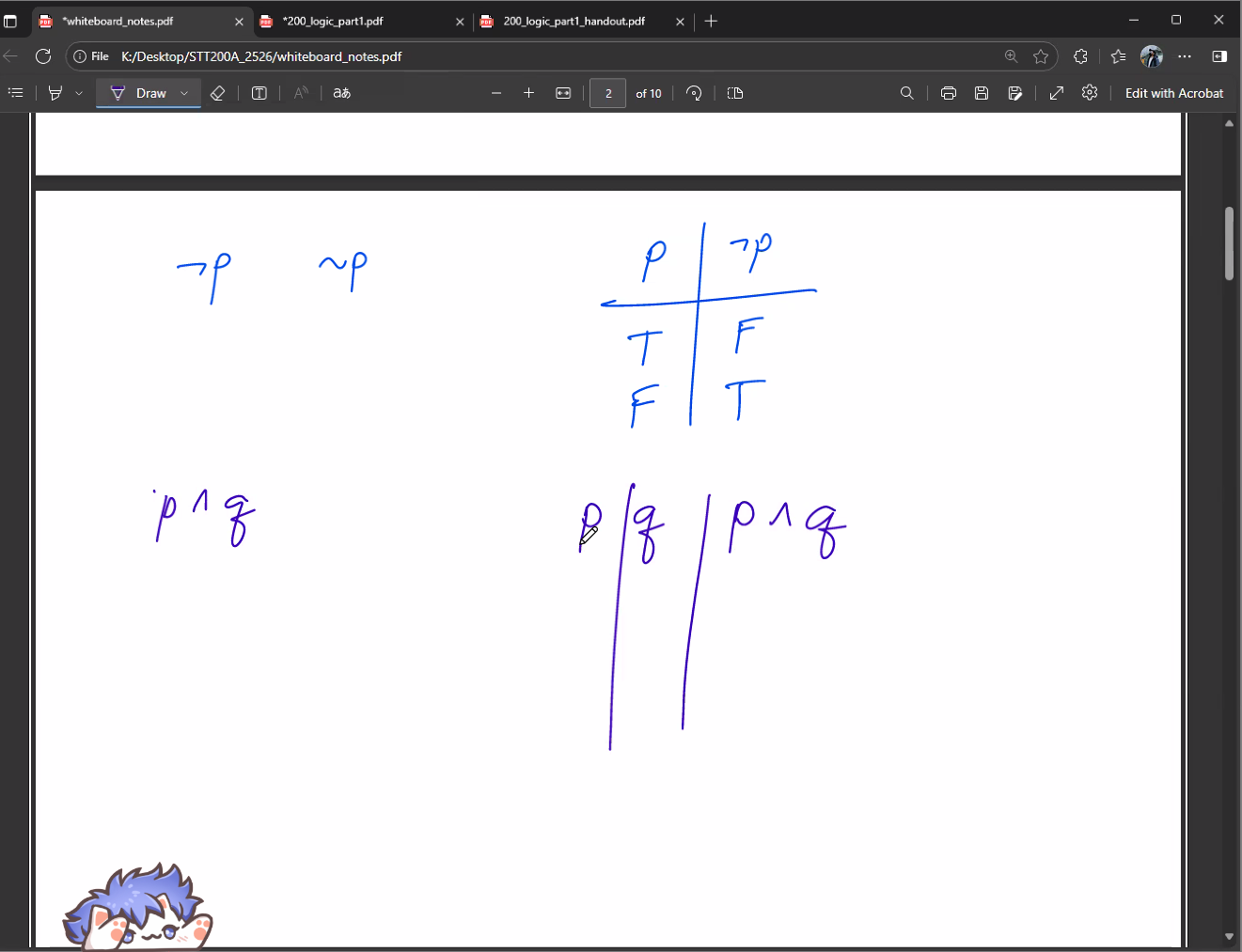
- A truth table is used to display the truth values of every possible combination of truth values of the statements that form a compound proposition.
Defn. Logical Operators
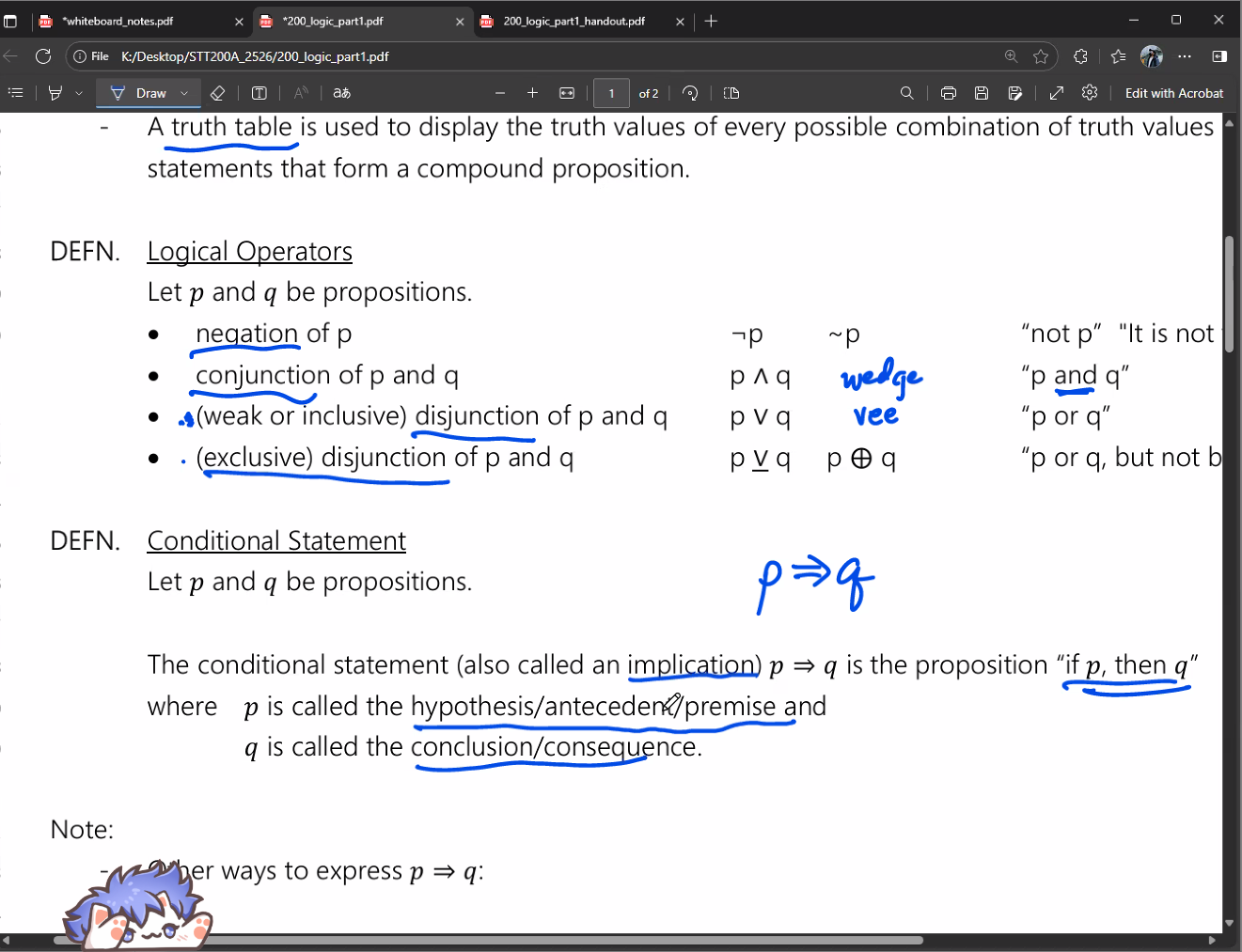
- Negation of p: , or ~, read as not p or it is not the case that p
- Conjunction of p: , combine proposition w/ “and”, true only if both are true
- Inclusive Disjunction of p and q: , true if p or q or both is true
- Exclusive Disjunction of p and q: or , true if only p or q is true
Defn. Conditional Statement
- Let and be Propositions. The conditional statement (also called an implication) is the proposition
- where is called the hypothesis or antecedent or premise, and
- is called the conclusion or consequence.
Other ways to express
- if p, q
- q if p
- q whenever p
- q when p
- p is sufficient for q*
- a sufficient condition for p is q*
- q is necessary for p**
- a necessary condition for q is p**
- p implies q
- q follows from p
- q unless
- q if not
- q only if p
- Note: 5 and 6 are both using the term sufficient, meaning if q is proven to be true, then p could automatically be proven true.
- *Note: 7 and 8 are both using the term necessary, meaning if p happened, then q has happened or will happen as well.
Other forms of Conditional Statements
- The converse of is
- The inverse of is
- The Contrapositive of is
- The negation of is , which is
Defn. Biconditional Statements
- Let and be Propositions. The biconditional (also called a bi-implication) is the proposition “p if and only if q”
- which is true if both p and q have the same truth values.
Other ways to express
- p is necessary and sufficient for q
- if p then q, and conversely
- p iff q, iff is read as if and only if
Defn. Compound Proposition
- A compound proposition is a
- tautology () — if it is true for all possible combinations of truth values of the component statements
- contradiction or absurdity — if it is false for all possible combinations of truth values of the component statements
- contingency — if it is neither a tautology or contradiction
Defn. Logical equivalents
- The compound propositions p and q are called logically equivalent if is a tautology.
Thm. Logical Identities (Rules of Replacement)
- Given propositions , tautology , and contradiction , the following logical equivalencies hold:
- Commutative Laws: , OR
- Associative Laws: , OR
- Distributive Laws: , OR HW MATH REASONING
- Identity Laws: , OR
- Negation Laws or Rule of Excluded Middle: , OR
- Double Negative Laws:
- Idempotent Laws: , OR
- Universal Bound Laws or Domination Laws: OR
- De Morgan’s Laws: , OR HW MATH REASONING
- Absorption Laws: OR
- Negations of t and c: , OR
- Material Implication: HW MATH REASONING
- Material Equivalence:
- Contrapositive or Transposition: