supposedly w3s2 pero wala talagang session nung monday sana okay ka sir lowk pero wtf
Origin and Maintenance of Living Systems
What is a system?
Definition
- A set of interacting parts that work together as a whole.
- Can be physical (solar system or ecosystem), biological (the human body), or abstract (MATH MODELS AND ECONOMIES MENTION !!!!!!!!)
Features of a system
- Boundaries - Elements included in the system
- Components - Parts that make up the system
- Interactions - How components affect one another
- Inputs and Outputs - Energy, matter, or information that flows through the system
it all comes back to STT200a
Example: The Human Body
- has boundaries (the heart—which is inside the skin?—is part of the body)
- has components (we have hearts and lungs and stomachs and all that ewie ewie stuff like guts and blood)
- has inputs (food and oxygen and stimuli and stuff)
- has processes (digestion and breathing and whatever u call neurological processes)
- has outputs (waste and sweat and energy gain and response to stimulus)
What makes a system “alive”?
- Order and Organization: Made of parts arranged in a structured way that works together
- Energy Use and Metabolism: Needs energy and materials to grow, stay alive, and do activities
- Information Storage and Transfer: Carries instructions (e.g. DNA) and passes them on
- Self-Replication and Evolution: Can make new life and change over time
A living system is one that is organized, uses energy, stores and transfers information, can reproduce and evolve, and maintains itself as a dynamic whole.
How can water support life? Why is it so special?
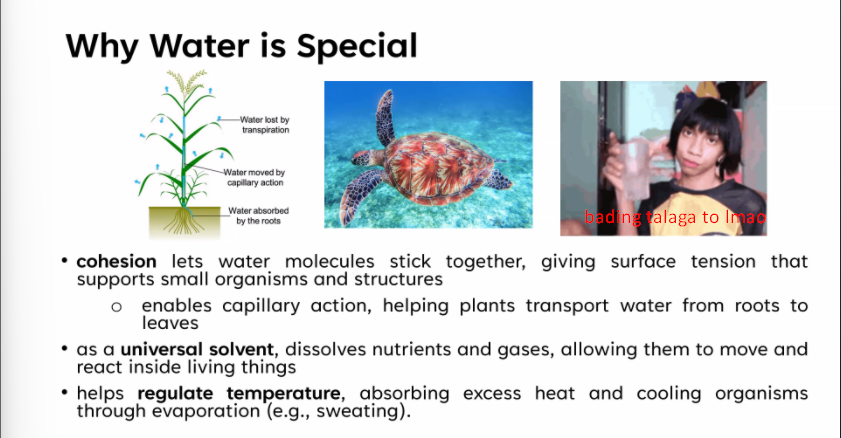
- Cohesion lets water molecules stick together, giving surface tension that supports small organisms and structures. Enables Capillary Action, helping plants transport water from roots to leaves.
- As a universal solvent, it dissolves nutrients and gasses, allowing them to move and react inside living things.
- Helps regulate temperature, absorbing excess heat and cooling organisms through Evaporation (e.g. sweating)
Biomolecules, the Building Blocks of Life
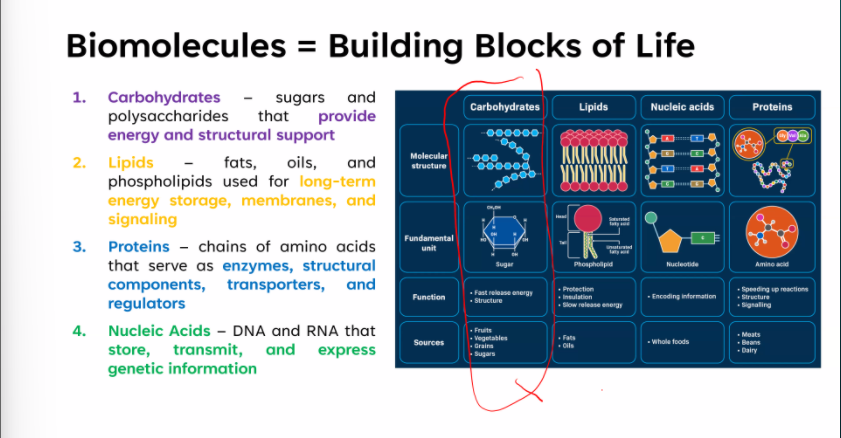
- Carbohydrates: Sugars and polysaccharides that provide energy and structural support.
- Lipids: Fats, oils, and phospholipids used for long-term energy storage, membranes, and signaling
- Proteins: Chains of amino acids that serve as enzymes, structural components, transporters, and regulators. Barbie yarn!
- Nucleic Acids: DNA and RNA that store, transmit, and express genetic information.
Energy in Life
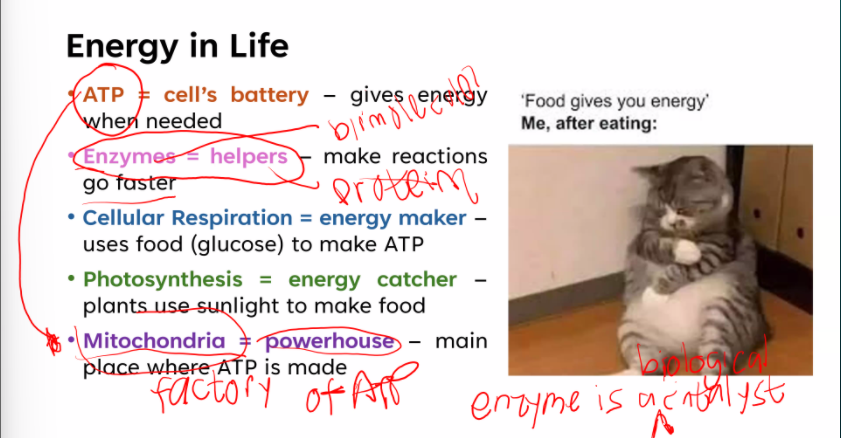
- ATP (Adenosine Triphosphate): Cell’s Battery
- Enzymes: Helpers (makes reactions go faster)
- Cellular Respiration: Energy maker (uses food to make ATP)
- Photosynthesis: Energy catcher
- Mitochondria: Powerhouse and ATP factory
CENTRAL DOGMA OF BIOLOGYYYYYYYYYYYYYYYYYYYYYYYYYYYYYYYYYYYYYYYYYY MY GOAT
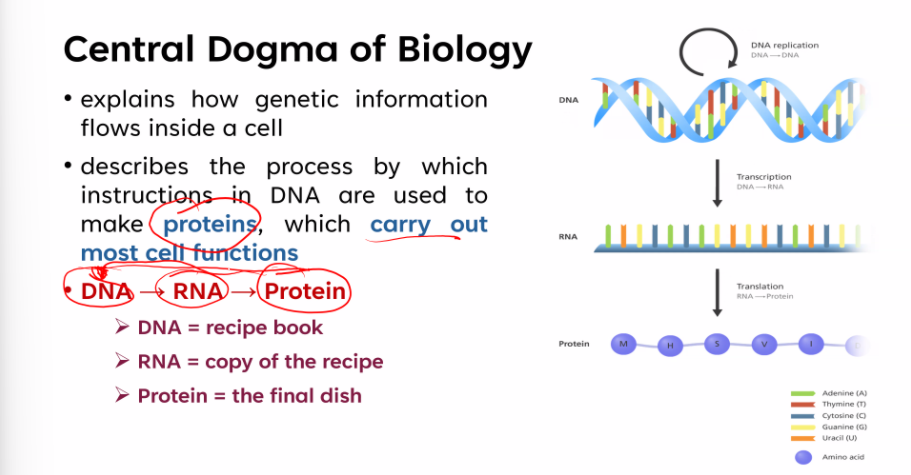
- Explains how genetic information flows inside a cell
- Describes the process by which instructions in DNA are used to make proteins which carry out most cell functions
- DNA → RNA → Protein
- Transcription → Translation
- DNA: Recipe Book
- RNA: Copy of the recipe
- Protein: The Final Dish
1. DNA and Replication
- Has 2 strands (double helix shaped)
- Made of nucleotides: Sugar, phosphate, and a base
- Base Pairs: AT, GC
- Copies itself before a cell divides
- Stores genetic information
- oh yeah and dna has to be transcripted into rna BECAUSE so u have to have two before u divide into two para then getsch ba
2. Transcription
- DNA instructions are copied into RNA one gene at a time
- Done by RNA Polymerase, the “copying machine” enzyme
- Happens in the nucleus
- Only one strand of DNA is used called the template strand
- Base Pairing: A in DNA pairs with U instead of T
- mRNA is produced (messengerRNA)
3. Translation
- mRNA is translated into amino acids
- RNA is read in Codons or groups of 3 bases
- AUG: Start codon
- UAA, UAG, UGA: Stop codons
- Happens in the cytoplasm, specifically the ribosome
What happens to proteins after translation?
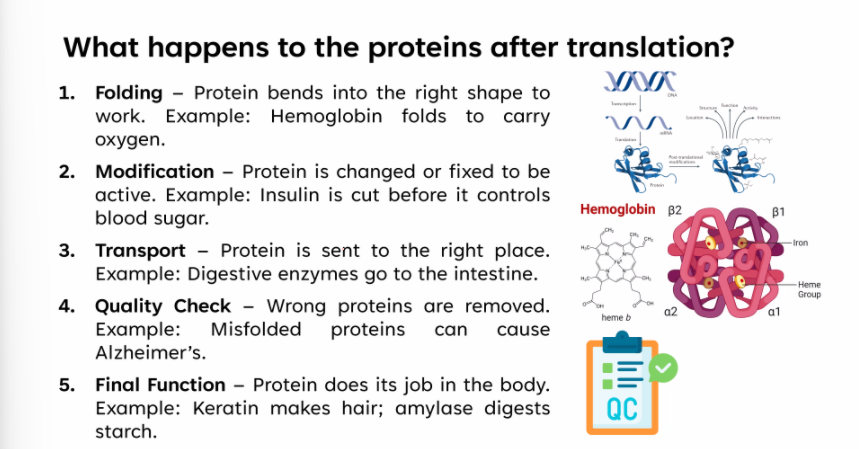
- Folding:
- Modification:
- Transport:
- Quality Check:
- Final Function: